
TADA
A research project exploring the potential of AI-assisted air traffic control
TADA (Terminal Airspace Digital Assistant) is a pan-European research project exploring how historical air traffic management data and machine learning can be used to support air traffic controllers’ decision-making in busy terminal manoeuvring areas (TMA).
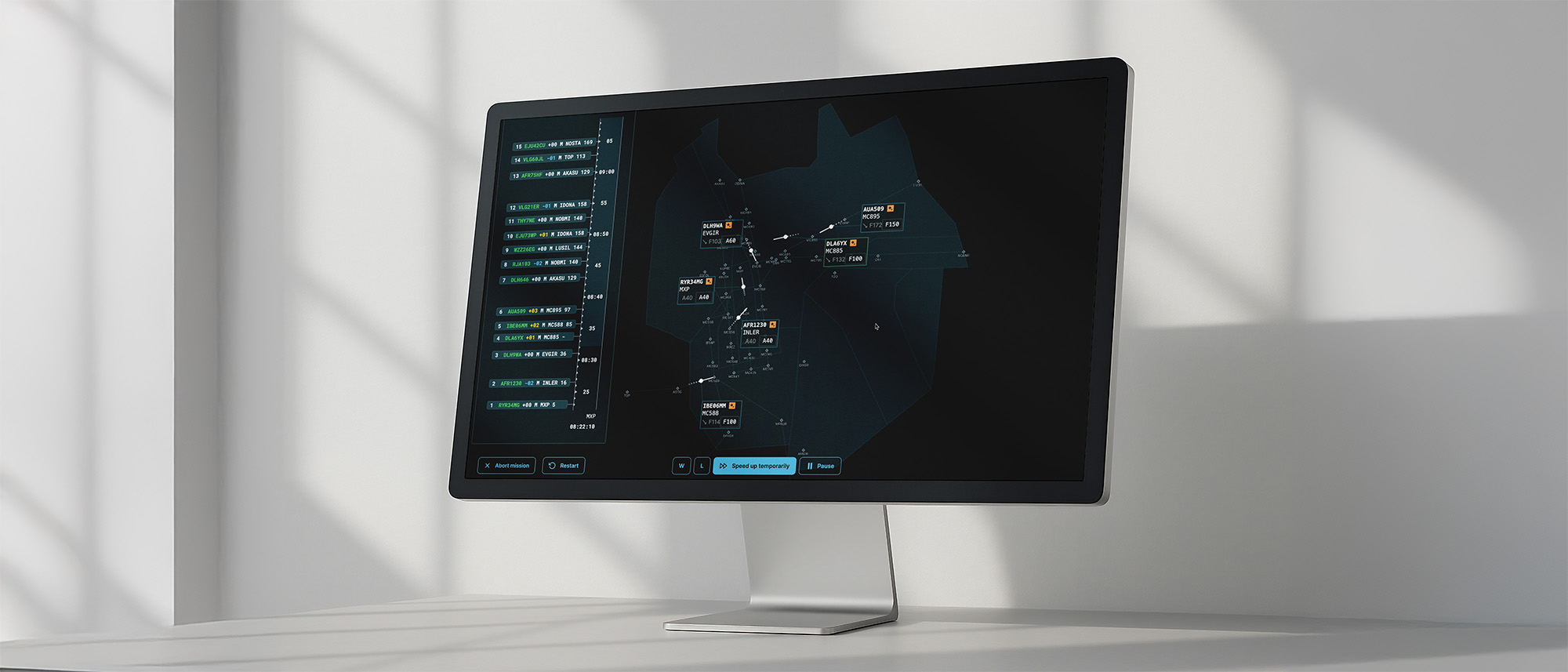
As concrete outcomes, the project delivers machine learning–based algorithms, related research findings, and scientific publications. In parallel, TADA builds practical, experience-based understanding of how responsibilities can be shared between humans and artificial intelligence in air traffic control. The results provide a foundation for further research and enable the future development of decision-support systems.
The project’s objective is to investigate how a human-centred digital assistant could genuinely enhance safety, traffic flow, and airspace capacity management—without seeking to automate or replace the role of the air traffic controller.
Monad’s role
Monad participates in the TADA project as an expert in software development and applied artificial intelligence. Monad’s work focuses on AI research and development, the implementation of a validation user interface, and the development of a simulation environment in which the assistant’s behaviour can be evaluated and tested in a research setting.
Within the project, machine learning models have been trained using extensive historical data on aircraft trajectories and air traffic controllers’ decision-making across different traffic scenarios. The goal is not to automate air traffic control, but to generate decision-support suggestions based on previously observed situations and identified operational patterns. AI acts as a supporting tool—not as an autonomous decision-maker.
Monad has developed a simulation environment that enables realistic modelling of air traffic control scenarios and safe evaluation of the digital assistant during the research phase. The simulations are also used to assess how suggestions are presented to controllers in a clear, practical, and operationally meaningful way through the human–machine interface (HMI).
The simulation environment has been tested in Italy with local air traffic controllers under conditions that closely reflect real operational environments. Feedback from these tests has been used to evaluate and further develop both the AI assistant and the associated user interface solutions.
Concrete development areas in the research phase
Within TADA, solutions are developed and tested in a research environment. From Monad’s perspective, the key focus areas include:
- Use of historical data for training machine learning models and identifying operational patterns in traffic situations.
- Simulation and validation environment for safely modelling air traffic control scenarios and evaluating the assistant’s behaviour prior to any potential operational use.
- Human-centred interface design (HMI), focusing on how decision-support suggestions are presented so that they genuinely assist controllers in real-world decision-making.
TADA is a research and development project, not a finished product. The project explores and validates the potential, limitations, and prerequisites of AI-assisted decision support for the future of safe and efficient aviation.
Towards better decision support
The expected impact of TADA lies in providing air traffic controllers with improved decision support in congested TMA environments. The aim is smoother traffic flows, better predictability, and enhanced safety. More efficient use of airspace also contributes to reduced delays and lower emissions.
International consortium
The project is coordinated by Ingenav (Spain). In addition to Monad, the consortium includes Deep Blue and ENAV from Italy, Frequentis Orthogon from Germany, and the University of Malta.
The international consortium brings together academic research, software development, and hands-on operational expertise. Its goal is to assess the potential of artificial intelligence in a realistic and demanding air traffic control environment.
About the Collaboration
About the Organization
TADA – Terminal Airspace Digital Assistant is a SESAR 3 research project developing and validating AI-assisted decision-support concepts and methods for air traffic management in terminal manoeuvring areas (TMA).
TADA is part of the SESAR 3 programme and is funded by the European Union’s Horizon Europe research and innovation programme (grant agreement No. 101166972).


Funded by the European Union. Views and opinions expressed are however those of the author(s) only and do not necessarily reflect those of the European Union. The European Union can’t be held responsible for them.
Skilled used
How to Get Started
1
Get in Touch
You don’t need a polished business idea or a detailed specification. The best way to move forward is to schedule a chat — send us a message or give Tomi a call!
2
Let’s Talk
We’ll go through your situation and needs together and see if there’s a way we could help. There’s no commitment, and naturally, no cost involved.
3
We’ll Make You a Proposal
Once we understand your needs better, we’ll put together a proposal on how we recommend moving forward.
Let’s Connect
Let’s go through your situation and needs together so we can make a proposal on how to move forward.
-

Tomi Niemenmaa
Head of Sales
Related Content
-

ALSO: Renewal of the End-of-Life Software System
-
Kalmar: Development of the TechSight Portal
-

Qt: Design, cloud technology, and data analysis – implementing Qt Insight